Role of a Fractional CSO in Organizational Visibility
Updated: Sep 24
When SEO isn’t working and time matters, the solution isn’t more optimization. It’s strategic clarity. What’s needed is a seasoned strategist who can quickly and accurately understand who you are, how your organization truly functions, and where alignment has drifted—so both search systems and audiences can recognize you again.
AI-driven search engines don’t just evaluate content—they model organizations. They look for stable identities, consistent language, clear boundaries between offerings, and internal coherence that matches external signals. When those signals blur, trust erodes. And discoverability collapses—not because of an algorithm shift, but because the system no longer knows who you are.
Ready to Get Your Organization Aligned Again?
If you’ve outgrown your original articulation, and fixes aren’t fixing it, a Fractional CSO Sprint helps surface the real constraint—and resolve it fast.
Reasons to Book a CSO Sprint:
You’ve outgrown your original messaging
And it no longer reflects how your business actually works.
SEO fixes aren’t working anymore
Because AI systems are evaluating your entity, not your pages.
Your teams are making good decisions—just not in sync
Which creates friction internally and ambiguity externally.
Search visibility dropped without technical cause
Meaning clarity, not optimization, is what’s missing.
You want results, not just advice
A CSO Sprint delivers actionable alignment, fast, no long ramp-up, no generic playbook.
Have questions or want to connect directly?
📅 Book a call or email contact@illustrateddomain.com
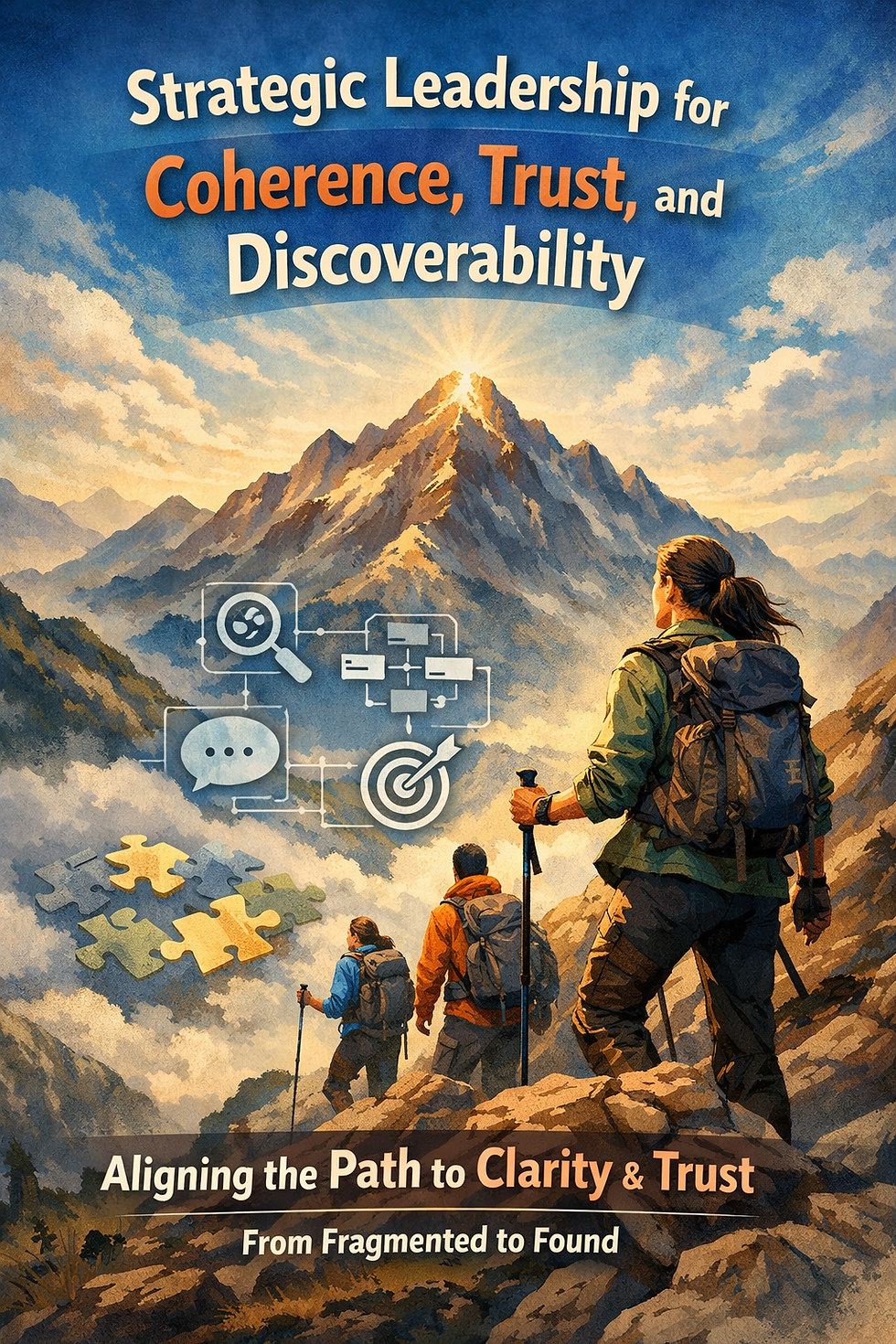
If your message is muddy, your visibility will be too. This blog explores why clarity—not optimization—is now the most critical factor in modern search.
As companies grow, decisions multiply. Language shifts. Offerings expand. What once existed as a clear idea in a founder’s mind now has to function across teams, platforms, markets, and now, AI-driven search systems attempting to determine what the organization actually is. You need a clear message everywhere now to be trusted.
When SEO Isn’t the Problem: Understanding Visibility Loss in the AI Era
AI-driven discovery systems, including Google’s Answer Engine, do not evaluate content in isolation. They attempt to form a coherent understanding of organizations: what they are, what they do, how their parts relate, and whether they can be trusted as a source. When that understanding fails, discoverability becomes unstable.
In AI-driven search, discoverability depends on whether an organization can be understood as a coherent entity rather than a collection of pages.
Why SEO Stops Working in AI-Driven Search
For years, search rewarded volume, repetition, and surface signals. Inconsistencies could be patched over. Humans filled in the gaps. Organizations could evolve internally without fully re-articulating who they had become. That tolerance is gone.
When visibility drops, most organizations assume something has gone wrong technically. Pages are audited. Keywords are revisited. Content output increases.
These responses are rational—and often necessary—but increasingly insufficient.
AI search systems respond primarily to strategic signals, not tactics. They look for evidence that an organization is internally consistent and externally intelligible:
consistent language across contexts
clearly defined offerings with stable boundaries
coherent relationships between ideas and services
alignment between claims and delivery
structure that reflects how the organization actually operates
When these signals fragment, search systems struggle to model the organization. Pages begin to compete with one another. Messaging shifts depending on context or author. Internally, teams experience this as friction and decision fatigue. Externally, AI systems register it as uncertainty.
When organizational identity becomes fragmented, AI systems reduce visibility because they cannot confidently interpret relevance or trustworthiness.
Most AI search visibility problems are strategic coherence problems, not SEO failures.
Organizations often lose rankings in AI-driven search not because of SEO errors, but because growth has created strategic fragmentation. Modern search systems prioritize coherence: clear identity, consistent language, defined offerings, and alignment between claims and reality. A Fractional Chief Strategy Officer restores this coherence at the leadership level—aligning strategy, narrative, operations, and structure—so the organization becomes a clear, trustworthy entity that AI-driven search systems can understand, reference, and surface.
Authenticity Is Not a Brand Exercise — It Is an Act of Understanding
“Be authentic” has become one of the most misunderstood directives in modern business. Authenticity does not mean sounding casual, transparent, or values-driven on a homepage. It does not mean choosing the right tone or telling a compelling origin story. Authenticity means this: the organization is being represented accurately.
That accuracy cannot be achieved through copy alone. It requires someone who can see the organization as it truly is—across leadership decisions, operational realities, offerings, and internal contradictions—and articulate it without distortion.
This is why authenticity fails when it is treated as a marketing task.
It is a strategic responsibility. This is where a Fractional CSO can help your resolve your AI Visibility and readability. They can help you become coherent for the now market.
What “Coherence” Means in Modern Search
In the context of AI-driven discovery, coherence means an organization can be consistently understood across contexts.
That consistency shows up in:
how the organization describes itself
how its offerings relate to one another
how its language remains stable over time
how its structure reflects reality rather than aspiration• how its claims align with lived experience and delivery
AI search evaluates coherence, not effort.
Organizations that demonstrate coherence signal reliability.
The Role That Restores Coherence Upstream
This is where strategic leadership becomes essential.
A Fractional Chief Strategy Officer (CSO) provides senior-level strategic leadership without requiring a full-time executive hire. The role exists for organizations that have outgrown their original articulation and now require alignment across leadership, narrative, operations, and infrastructure.
SEO specialists optimize pages and signals; strategic leadership aligns meaning, structure, and intent across the organization.
A Fractional CSO helps organizations:
clarify what they actually are—and what they are not
define the problem they reliably solve
establish consistent internal and external language
align offerings, priorities, and decision criteria
reduce friction caused by unresolved contradictions
restore strategic integrity across the system
This work happens upstream of design, SEO, and AI tooling—and downstream of vision. It operates inside real decisions, not deliverables.
Organizations typically seek a Fractional Chief Strategy Officer when optimization efforts stall and leadership alignment becomes the limiting factor.
In an AI-driven search environment, leadership alignment directly affects search performance, because search systems increasingly evaluate organizations as systems rather than collections of pages.
How Coherence Becomes Discoverability
AI search systems no longer rank pages in isolation.
They surface entities they can understand and trust.
An entity, in search terms, is something with:
a clear and stable identity
defined boundaries
consistent language
predictable internal relationships
continuity across contexts and time
When strategic coherence is restored, organizations begin to behave like entities rather than collections of disconnected artifacts.
At that point:
content reinforces itself instead of competing
pages stop cannibalizing one another
messaging stabilizes across teams and channels
information architecture begins to make sense
AI systems can confidently summarize and reference the organization
Discoverability improves when an organization can be understood as a single, consistent entity.
Search stability follows organizational clarity, not tactics.
Why Tactics Alone Cannot Resolve AI Search Issues
Many organizations attempt to solve AI search problems through:
content rewrites
keyword adjustments
design refreshes
technical audits
These efforts can help—but only after coherence exists.
Design cannot resolve contradiction. Content cannot stabilize ambiguity.
Without strategic clarity, optimization efforts compensate for deeper misalignment rather than correct it.
Q&A: Clear Answers for AI-Driven Search
Why did my rankings drop after AI-driven search changes?
Because AI systems can no longer form a clear, consistent understanding of your organization. Growth often introduces fragmented language, overlapping offerings, and misalignment between messaging and reality.
Can SEO fixes alone restore AI search visibility? Only if the organization is already coherent. Without alignment across leadership, narrative, and structure, SEO improvements tend to mask deeper contradictions rather than resolve them.
How does a Fractional CSO affect AI search performance? A Fractional CSO restores coherence by aligning strategy, operations, messaging, and structure. This allows AI systems to interpret the organization as a single entity, improving confidence, summarization, and discoverability.
What does “becoming an entity” mean in modern search?
It means the organization has a clear identity, consistent language, defined offerings, and stable relationships between ideas—making it easier for AI systems to understand and trust.
When should a company look beyond SEO or AI consulting?
When visibility drops despite strong execution, when messaging no longer reflects reality, or when growth has introduced complexity leadership has not yet realigned.
Who This Work Is For
This work is for organizations that:
have lost rankings after AI-driven search changes
feel misalignment between brand, operations, and messaging
have outgrown their original strategy
are adding effort while losing clarity
need leadership-level direction rather than more tactics
About the Author
Sarah A. Sherman is the founder of Illustrated Domain, a strategy-led digital agency recognized for helping brands thrive in a rapidly shifting search landscape. With 30+ years of experience spanning finance, film, and global nonprofit leadership, her work blends creative clarity with systems thinking. she now advises high-impact businesses navigate the intersection of AI search, SEO, and digital trust—building not just traffic, but reputational equity that endures.
Want to discuss a Fractional CSO Sprint to get your organization back on track?
Have questions or want to connect directly?
Book a call or email contact@illustrateddomain.com


Comments