From 360 Unique Visitors to 20,623 in One Year.
Updated: Sep 29
One year. The same firm. The same expertise. A rebuilt digital architecture and traffic that grew by thousands of percent. Here's what actually happened, and why it happened.

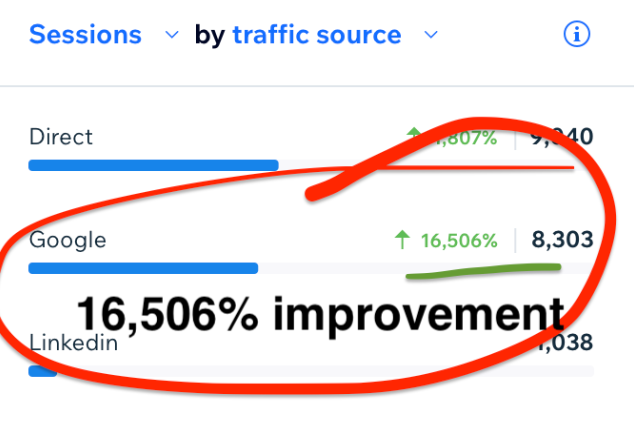
Those are real numbers, pulled directly from Wix analytics. April 2024–2025 compared to April 2025–2026. Same methodology. Same platform. Same client with the same expertise they'd had for years before we touched anything.
The expertise didn't change. The architecture did.

This isn't a firm that suddenly became more interesting. It's a firm whose digital infrastructure finally matched what it had always been. The visibility was latent. The architecture was suppressing it.
Why this gap exists for so many established firms
Here's a pattern we see constantly. A firm has been doing serious work for years. Their reputation is real. Their client relationships are deep. They have genuine category authority the kind that takes a decade to build.
And then someone searches for exactly what they do, and they're nowhere.
Not because they're unknown. Because their site was never built to be found. Metadata inconsistencies. Structural signals that confused search engines rather than helped them. Content that existed but was never surfaced to the right searches. Divisions that operated as separate online presences when they should have read as one authoritative whole.
"The site's scale and its complex network of content created overlapping messages and inconsistencies. The challenge was to simplify without erasing depth."
This is a technical problem. Not a content problem, not a brand problem, not a budget problem. The substance was already there. What was missing was the architecture that lets search engines — and increasingly, AI systems — understand it.
What technical SEO actually is
SEO is one of those words that means four different things depending on who's using it. Content SEO. Link-building. On-page optimization. And then there's the foundational layer that determines whether any of the rest of it can work at all.
Technical SEO is structural. Schema markup that tells search engines what each page is. Redirect mapping that preserves years of accumulated equity. Internal linking that forms legible topic clusters. Metadata calibrated to actual search intent, across every page. Navigation that signals hierarchy to crawlers. Content architecture that makes an entire site legible as a coherent entity.
The other disciplines are additive at the margins. Technical SEO raises the ceiling that everything else operates beneath. A 2,503% jump in sessions is a technical SEO outcome — not something content calendars or backlink campaigns produce on their own.
And it's worth noting: the same structural signals that make sites legible to search engines are what make them citable by AI systems. ChatGPT, Perplexity, Claude, Gemini — they all depend on clean schema, semantic clarity, and hierarchical content relationships to decide what sources to surface in their answers. A site built for technical SEO is positioned for AI search. A site that wasn't stays invisible to both.
What changed in the rebuild
The engagement covered the full scope: rewritten content across every page, a new content architecture, structured internal linking, standardized metadata and H1s across 100+ pages, 404 repairs and redirect mapping to preserve legacy URL equity, and integration of multiple divisions under a single coherent digital identity.

All of it built on Wix Studio — a platform capable of exactly this kind of serious technical SEO work, though most agencies haven't learned how much of that surface is available to them. Dynamic metadata pulled from CMS fields at the template level. Schema implemented once and applied across entire content types. Redirect management with full equity preservation. Core web vitals handled at the hosting layer.
The assumption that serious technical SEO requires a custom development stack is not, in 2026, accurate.
What this means for your firm
A jump of this magnitude happens when the gap between where a site starts and where it could be is large. For firms with genuine offline authority — deep expertise, real client relationships, years of accumulated work — that gap is often very large indeed.
The question isn't whether your firm has something worth finding. It's whether your site has been built to let people find it.
What's your site actually capable of?
We'll identify the structural barriers preventing search engines — and AI systems — from understanding your site, and tell you what fixing them could unlock.
or call +1 (408) 335 7378
Sarah A. Sherman
Founder & Strategic Partner · Illustrated Domain
Builder of what comes next.
m: +1 (408) 335 7378
contact@illustrateddomain.com About the Author
Sarah architects digital platforms where brand clarity meets technical precision. With over 30 years in finance, digital markets, and global nonprofit leadership, she brings systems thinking to every build. LinkedIn


Comments