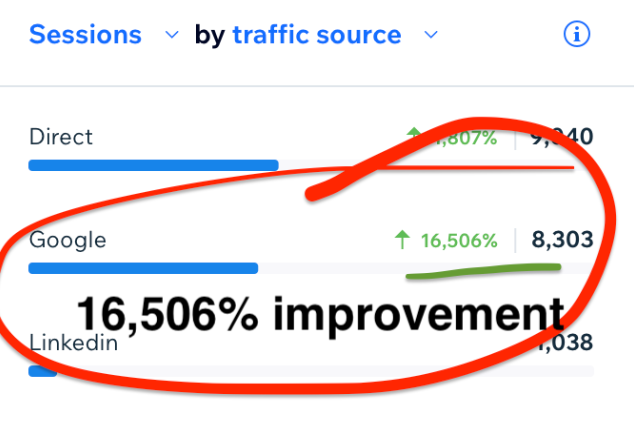
31,425% increase in direct visitors. Proof your brand matters.
When a digital presence finally matches its real-world reputation, something unexpected happens. People don't just find them. They come back looking for them.

Those numbers are real. Pulled directly from Wix analytics, same methodology throughout. But the number that matters most isn't the biggest one.
It's the word direct.
What "direct traffic" actually means
Most people assume traffic growth means more Google. Better rankings, more clicks, more strangers finding you for the first time.
Direct traffic is different. It means someone already knew who you were and went looking for you specifically. They typed the URL. They came back from a bookmark. They remembered the name.
You cannot optimize your way to a 31,425% increase in direct visitors. You cannot buy it with ads. It is the digital signature of a brand that became real to people - real enough to seek out deliberately.
A significant portion of direct traffic isn't people typing URLs from memory. It's word-of-mouth happening in real time: a recommendation sent over iMessage, WhatsApp, or Slack. Those clicks land with no referrer attached, which is why they show up as direct. For a business whose reputation has always traveled by referral, this is the digital fingerprint of that conversation. Someone said "you should check them out". The site didn't create the reputation. It finally gave the reputation somewhere to land.
"A rebuilt site doesn't just help people find you. It makes people remember you."
For creative studios and agencies, this distinction matters more than almost any other metric. Your reputation has always traveled by word of mouth. The question is what happens when someone acts on that word of mouth and lands on your site. Does it confirm what they heard?
Or does it quietly undermine it?
What we actually did was close the gap between reputation and digital infrastructure.
This wasn't a cosmetic refresh. It was a ground-up rebuild: brand strategy, site architecture, messaging, content structure, and search strategy working as a single system.

The copywriting and content strategy piece is where most creative studios leave the most on the table. A studio's work speaks for itself in person, in a pitch, in a portfolio review. Online, the words have to carry that weight instead. We rewrote the messaging from the ground up — not to sound impressive, but to be legible: to search engines, to AI systems, and to the right kind of client arriving for the first time.
We also teach companies how to maintain it. Organic SEO isn't a one-time fix it's a practice. Blog structure, internal linking, content cadence the foundation is only valuable if the team can build on it. That knowledge transfer is part of every engagement.
Why this pattern shows up for creative businesses specifically
Creative studios tend to have the same structural problem: exceptional offline reputation, underbuilt online presence. Referrals come in. Clients love the work. The portfolio is real. And the website is an afterthought something that exists but wasn't built with the same intentionality as everything else the studio produces.
The gap between real-world reputation and digital presence is exactly where these growth numbers live. The brand authority was already there. The infrastructure wasn't carrying it.
When you close that gap when the site finally reflects the studio's actual quality, speaks clearly to the right clients, and is structured for both human visitors and machine readers the latent reputation surfaces. People who already knew about you start finding you online. People who find you online start remembering you. The word-of-mouth loop that was always there starts compounding digitally.
That's what 35,129% looks like when you trace it back to its source.
The direct traffic figure is the standout.
A 31,425% increase in direct visitors is nearly unheard of. Direct traffic is the hardest category to move because it requires brand recall people have to remember you exist and choose to come back. Most agencies never touch that number at all because it lives outside what SEO or ads can manufacture.
For context on what's "normal":
A successful site rebuild with solid SEO typically produces 50–200% traffic growth in year one. An exceptional technical SEO engagement — like our Nova case — might produce 2,000–5,000%. These numbers are 35,000%. That puts this in a category most agencies never see in their entire portfolio.
What makes them credible:
The three numbers track together logically. Sessions, visitors, and direct traffic all moved in proportion. If one number were wildly out of sync with the others it would raise questions. Here they tell a coherent story a site that went from essentially invisible to genuinely active, with a user base that kept returning.
The real caveat: They started from near zero. A year later, people were seeking them out by name. That's the whole story. And that's exactly the pattern we see repeating across small businesses and studios at every scale.

What this means:
You don't need a massive budget or a dedicated marketing team. You need a site that's built with the same care you bring to your actual work one that speaks clearly, loads fast, earns search visibility, and makes the right impression the first time someone acts on a referral and types your name.
The numbers above aren't an outlier. They're what happens when infrastructure catches up to reputation.
How much of your reputation is your site leaving on the table?
We'll take an deep look at your digital presence: the structure, the messaging, the search visibility and tell you exactly what's holding it back from reflecting the business you've actually built.
or call +1 (408) 335 7378
Sarah A. Sherman
Founder & Strategic Partner ·
Builder of what comes next.
About the Author
Sarah A. Sherman is the founder of Illustrated Domain, a Wix Studio League Partner agency that architects digital platforms where brand clarity meets technical precision. With over 30 years navigating finance, digital markets, and global nonprofit leadership, Sarah brings systems thinking and strategic rigor to every build transforming complex organizational goals into websites that perform under pressure.


Comments